Stockton’s beach guru Stewart Farrell set to retire
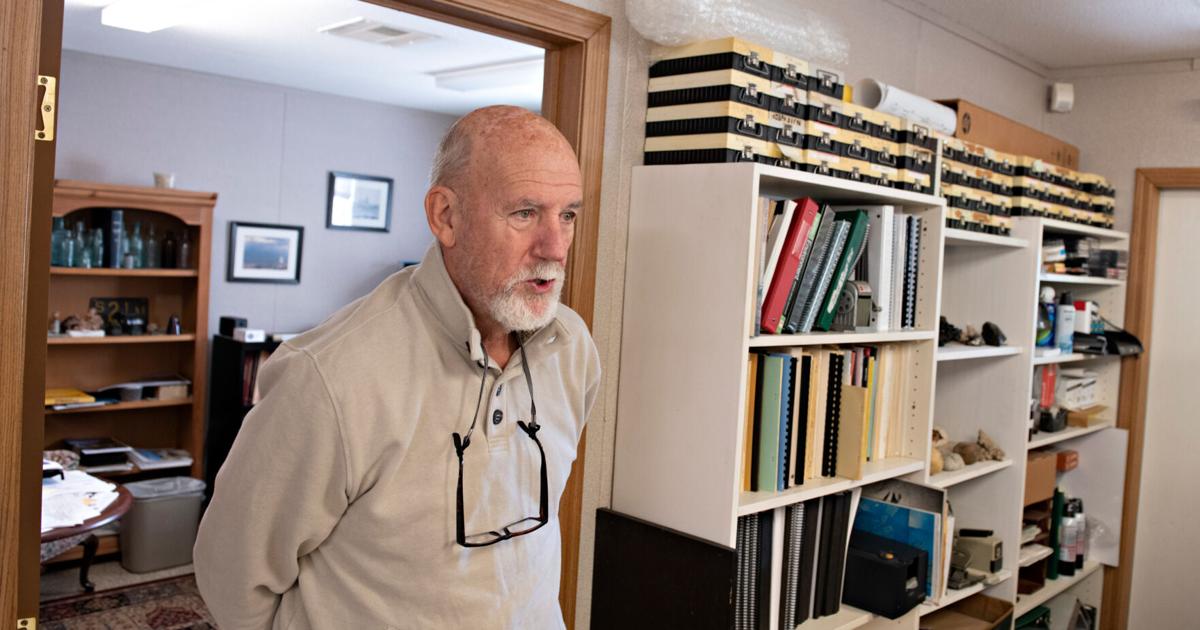
Stewart Farrell is set to retire from Stockton University after more than 50 years. Video by Matthew Strabuk, for The Press.
PORT REPUBLIC – When Stewart Farrell arrived for a job interview for Stockton State College, what is now the college campus in the Pomona section of Galloway Township was not much more than a clearing where there was once a pig farm.
He was hired, part of a group of 34 teachers who would start the new college, which later grew into a university.
Farrell founded Stockton’s Coastal Research Center 36 years ago. Since then, South Jersey has now grown accustomed to periodic, multimillion-dollar beach replenishment projects to fend off erosion, so much so that almost the entire New Jersey coastline is now under the jurisdiction of the Army Corps of Engineers.
Now 80, Farrell is set to retire as of Jan. 2, at the end of an era in coastal management in New Jersey.
“It is what it is. It’s time to go,” he said in an interview Thursday at his office at the Coastal Research Center, about five miles from the main campus by an estuary off the mouth of the Mullica River.
People are also reading…
In his time at the center, Farrell has helped shape policy for dozens of shore communities and worked to reshape beach policy in New Jersey, working with the state, the Army Corps of Engineers, and municipalities from Mantoloking to Cape May Point.
Throughout that time, he has sought to drive home the concept that barrier islands have always moved, and will continue to move into the future. It is only when they are loaded with amusement parks, boardwalks and summer rentals that the inevitable movement becomes an issue. That started a little more than a century ago, after the Civil War, when Atlantic City became a worldwide destination and summer resorts became big business.
“The whole idea that these shorelines are stable is just because we don’t live long enough to see anything different,” Farrell said. “If you lived 500 years, you’d have a whole different perspective on what goes on at the beach, and you might be a little less likely to put $6 million into a beachfront home.”
The local landscape has changed faster. Over 50 years, Farrell has watched it happen.
“I came here in 1971,” he said. “The first semester was held in Atlantic City at the Mayflower Hotel on Tennessee Avenue and the Boardwalk.”
The hotel was in rough shape, he remembers, and was demolished soon after the college moved out. That was before the casino boom, and no one had the interest or cash to renovate the property.
The best part, as Farrell recalls, was that each room had a bathroom, so he could clean up after a swim in the nearby ocean between classes.
Farrell originally studied chemistry, but was drawn to geology and unhappy with the idea of a life inside working in a laboratory.
It was right around that time, in 1957, when the Soviets launched Sputnik 1, the first artificial satellite. The launch prodded American investment in science education and eventually led to the space race of the 1960s.
But before all that happened, the Defense Education Act drove an increase in science scholarships, one of which Farrell obtained to attend the University of Massachusetts. There, he met a charismatic professor from Texas, Miles O. Hayes, who got him interested in the movements of coastal environments. Farrell wrote his doctoral thesis on a coastal area of Maine, and worked surveying the waterways in Valdez, Alaska, where crude oil would be shipped south to refineries.
Shore protection’s military origins
Hayes was an important figure in the study of beaches and coastal environments. Humans have been living along the water’s edge for millennia, but the study of coastal geology is a relatively recent field.
“The beach stuff got a big push during World War II, trying to figure out just how we were going to land on Normandy, because there’s a16-foot tide on the Normandy beaches, and that’s pretty damned significant if you’re running in with landing craft and hundreds of thousands of troops,” Farrell said.
The D-Day invasion of mainland Europe was a turning point in the war. Later, during the Korean War, the massive landing at Inchon presented similar problems, with a big difference from low tide to high tide.
“The study of coastal interaction into, say, 30 feet of water became a very hot item,” Farrell said.
In 1986, Farrell founded the Coastal Research Center, studying the coastal environments, including how sand erodes and returns to beaches, and the movement of barrier islands.
That was before the first federal beach replenishment project in Cape May in 1990. While many in the city point to efforts to revive the arts and the formation of the Washington Street Mall as vital spurs to the local economy, Farrell said the replenishment of the beach cannot be understated for a community founded as a summer resort.
“You could bass fish off Beach Avenue. The only thing that was between that and the water were the rocks,” he said. “Now, there’s almost 350 feet of sand there.”
In Ocean City, the second community to receive a federal beach replenishment project, along with a 50-year commitment to keep rebuilding the beach, high tides routinely reached under the Boardwalk.
“The north end of Ocean City was basically a pending disaster in 1985,” he said.
So far, there has been more than $1 billion spent on replenishing New Jersey beaches. According to Farrell, the project has worked amazingly well. The values of the communities protected from storms by those beaches have skyrocketed.
After a massive storm in 1962 devastated beach communities throughout South Jersey, towns turned to seawalls to fend of future storms. That can keep the water out, Farrell said, but does not help with beach erosion.
“Rocks are great protection for the homes, but they’re lousy for recreational use and the whole reason people come here is to use the beach,” he said. “Rocks leave no real beach.”
After Superstorm Sandy a decade ago, the storm most often compared to 1962, the post-storm response has been better than any other he’s seen, Farrell said.
The biggest change came in the 1980s, he said, when the New Jersey Office of Coastal Engineering began to bond for beach projects, creating stable funding for future efforts.
Farrell used the example of the Halloween storm in 1991, before the first federal beach project in Ocean City. Waves ripped apart a significant section of the Boardwalk, inflicting $4 million worth of damage. In 1992, a dredge brought sand from the Great Egg Harbor Inlet onto the beaches, and a dune line was built in the project area.
In December of 1992, another, worse storm hit the area “and they lost exactly zero dollars on the ocean front,” Farrell said.
Finding (or building) higher ground
But however effect beach replenishment projects are, they will not be enough to fend off rising seas indefinitely.
According to Farrell, rebuilt beaches are effective against storm damage from pounding waves, but the major concern as sea levels rise will be flooding. Current projections expect sea levels to rise between 2 to 7 feet by the end of the century.
If you have a back bay bulkhead 3 feet above high tide, but sea level rises 4 feet, you will have a problem.
He sees three possible solutions for beachside communities: all seawalls, which will require pumping all rainwater out because the water outside will be higher than inside, or bringing in massive amounts of fill from somewhere to raise entire communities 10 feet, bringing roads, infrastructure, Homes and businesses above the water level.
“OK, you’re cool for another 100 years, maybe,” he said.
But that would require an extraordinary investment, dwarfing the billion-dollar spending on beach projects.
“Or you can hand the keys back to the bank and say ‘See you,’ and walk away,” he said.
Regardless, Farrell said he does not expect to live long enough to see what happens.
Farrell stopped teaching more than a decade ago. He said as the Coastal Research Center became busier, he could not do both jobs well.
“I said let’s let the younger generation do the teaching and I’ll just get paid to do the beach,” he said.
The research center has a staff of nine, including Farrell, and six students work there. Before the interview, he was working on a report for the city of Cape May. The center is funded by clients, not by Stockton, and he hopes it will continue without him.
“The school makes money, so I don’t see why they’d want to get rid of us,” Farrell said.
He and his wife live in Port Republic, but he said he does not know if that’s where he will remain. He said he plans to remain close to the ocean wherever they end up, but will make sure it is somewhere at an elevation of 15 feet or more above sea level.
Contact Bill Barlow:
609-272-7290
Twitter @jerseynews_bill
Get local news delivered to your inbox!
Subscribe to our Daily Headlines newsletter.