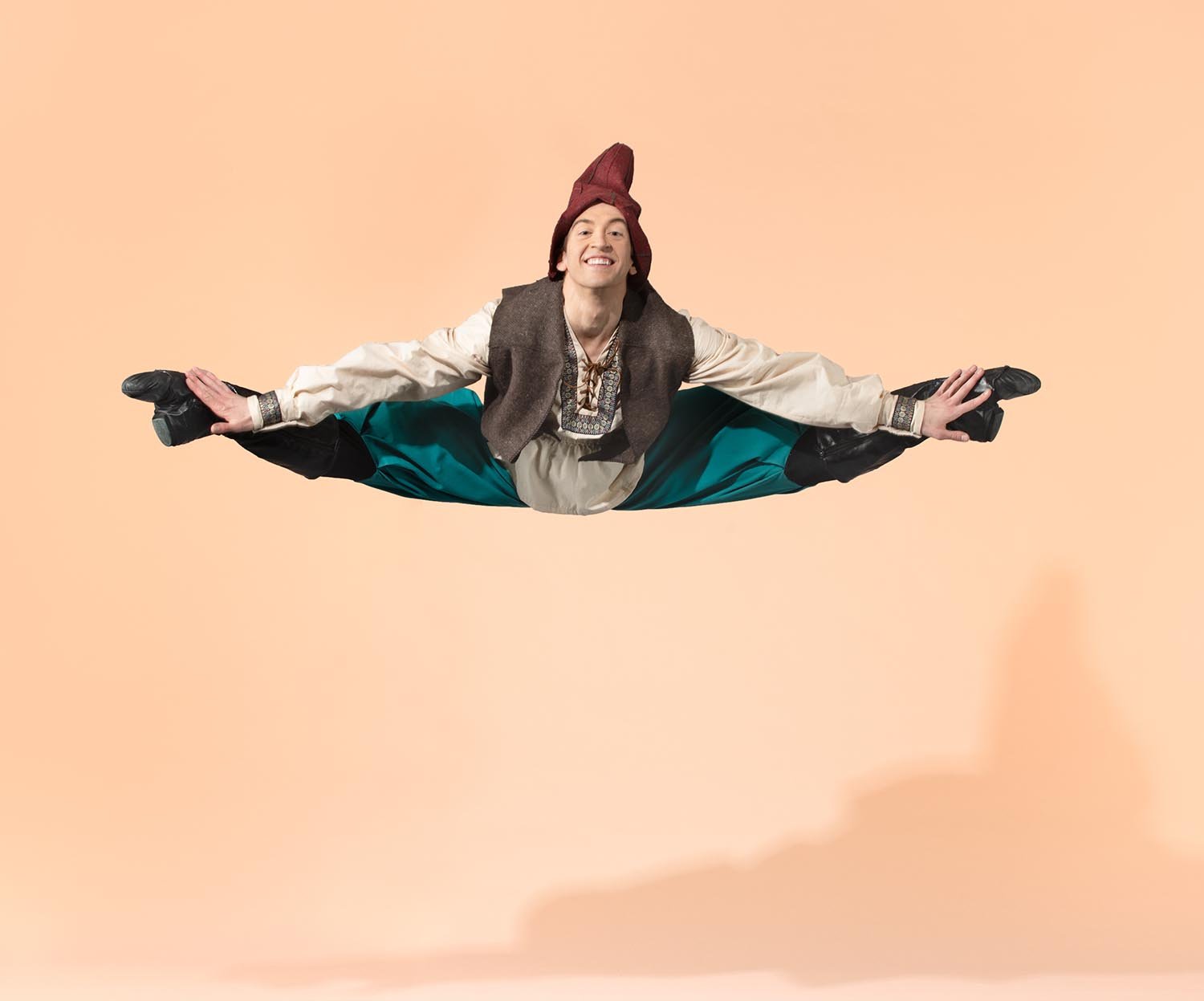
Sacramento Ballet puts on a hometown ‘Nutcracker’
curtain up
What: SacBallet’s ‘Nutcracker’
Where: SAFE Credit Union Performing Arts Center, 1301 L St. in Sacramento
When: Dec 10-24, 2 pm and 7 pm (check with box office for times and dates)
Price: $33-99
Tickets: www.sacballet.org or call the Box Office at 916-808-5181
By Timothy Nutter
Special to The Enterprise
This December, Sacramento Ballet will present a delicious confection for the whole family, its hometown version of the “Nutcracker” at the SAFE Credit Union Convention Center. This new version of the “Nutcracker” premiered just last year and features original choreography by current and former dancers of the company, as well as Tchaikovsky’s musical score played by the Sacramento Philharmonic Orchestra under the baton of Andrew Grams, a conductor specializing in ballet music .
Artistic director Anthony Krutzkamp envisioned the show as “a ‘Nutcracker’ that is Sacramento’s own,” with original staging and dances by three choreographers, each of whom has strong connections to Sacramento: Julia Feldman, Colby Damon and Nicole Haskins. Besides the talents of Sacramento Ballet’s professional dancers and a collective cast of more than 150 local children, audiences can look forward to gorgeous costumes, magical sets and scenery, and enchanting music by an orchestra of 38 musicians.
The original “Nutcracker” ballet was staged in Saint Petersburg in 1892 as a double-bill with Tchaikovsky’s opera “Iolanta,” with choreography and staging by Lev Ivanov and Marius Petipa. The ballet’s libretto was loosely based on a short story written by an early 19th-century German polymath Ernst Theodor Amadeus Hoffmann.
A classic tale of Romanticism, “Nutcracker and Mouseking” recounts the adventures of a 7-year-old girl, Maria, who receives a Nutcracker doll for Christmas from her godfather, Drosselmeier. Overflowing with magic, dreams, and eerie dopplers, the story stresses the natural goodness of children against their oppressive parents, children who find room for play, imagination and growth in their toys and dreams.
When I spoke with Krutzkamp and Feldman by phone, both emphasized how meaningful it was to build a new “Nutcracker” made by dancers who had worked with the company and had memories and connections to the city. Even though the company already had good choreography for the “Nutcracker,” Krutzkamp felt the extra work was more than worth it: “Finding a ‘Nutcracker’ that was more Sacramento’s own was really important for us because we really hadn’t tapped into what resources we had as far as choreographers that came out of Sacramento Ballet or, like Julia (Feldman), who were here.”
The three choreographers met a half-dozen times to discuss what the overall approach would be, wrangling over the possibilities for hours on end — all before setting a single step. In question what to adjust, what to change outright, and what to keep traditional. Feldman explained that “for all three of us it was really important to be very thoughtful in creating it in a way that was cooperative and all three of us were giving input … The storyline throughout is where we spent a lot of time talking and making sure that we were on the same page, as far as the narrative, and the journey of Clara.”
Each choreographer brought different strengths and values derived from having worked in numerous Nutcracker productions throughout their respective careers. And limiting their imagination was the imperative to use most of the existing costumes and scenery (though this year will see the addition of new Peppermint costumes). But in the end, a strong consensus emerged from their summits. “The three of us together,” Haskins said, “were much better than the sum of each of us individually.”
The new version keeps the traditional story and most of the characters audiences expect, while providing extra opportunity and ownership for these local artists. All of the second act divertissements now depict things and qualities the choreographers felt would appeal broadly to children: Mother Ginger, a dancing gnome, sapphires, orchids, cinnamon and peppermint. But you can bet the mice still run riot. Clara still throws her shoe. And the chance of snow is still 100 percent.
Each of the three choreographers took primary responsibility for one of the large group sections of the ballet. Damon took on the Act 1 party scene, Feldman the beautiful Waltz of the Snowflakes, and Haskins the iconic Waltz of the Flowers in Act 2. Yet the three choreographers also took care to communicate and plan so that the ballet could be “as cohesive and thoughtful as possible.”
Feldman grew up in Davis, while attending a Natomas performing-arts charter school, which led her to study at Pamala Hayes’ ballet studio in Sacramento. She joined the company in 2011 and has choreographed numerous works for the company’s annual Beer and Ballet shows, for the School of Sacramento Ballet, as well as works for the affiliated Capital Dance Project.
While Feldman began with the Royal Ballet curriculum taught by Hayes, she has drawn an eclectic mix of influences into her performance and choreographic toolkit since then: “I think one of the cool things about dancing (at Sacramento Ballet), and maybe in America in general, is that you can pull different styles that you like or that fit best for whatever you’re dancing.” Feldman expressed her appreciation for this rare opportunity to collaborate on new choreography for the “Nutcracker,” calling it “an awesome honor.”
Damon currently works for Sacramento Ballet as their Education and Outreach Coordinator but he previously danced with the company from 2002 to 2007, as well as with numerous other professional companies. He has received choreography commissions from BalletX, Nashville Ballet and American Repertory Ballet, as well as many other dance companies and university programs.
He grew up in Richmond, Va., but since landing his first professional dancing gig at Sacramento Ballet, he has found a second home here. Damon views the annual “Nutcracker” cycle as much more than just holiday entertainment. “‘The Nutcracker,’ in a big-picture sense, is really a communal ritual,” Damon said. “It’s always seasonal, it corresponds with the solstice, it’s about renewal and rebirth. And all of those themes are present in the story and just the involvement of what it means to grow over time … To see it year after year, to be in it year after year, to grow in the roles, and to revisit it and revisit the music. It mimics that celebration of cycles, which is ultimately what this time of year is about.”
Haskins danced professionally for Sacramento Ballet, Washington Ballet, and Smuin Contemporary American Ballet, but since 2019 has turned exclusively to choreography, with commissions coming from Sacramento Ballet, Richmond Ballet, Smuin Ballet, Dayton Ballet, and Oregon Ballet Theater, as well as many ballet schools around the nation. When I asked her how she approached choreographing the sugar plum fairy variation, with its universally recognized celesta melody, she gave credit both backwards and forwards.
On the one hand, she kept some traditional choreography, allowing her to “rest on the shoulders of giants.” On the other hand, she empowered the several performers to tailor the ending “manège” section of the variation to steps which that dancer performs best. “I definitely helped shape what they created but I allowed them the freedom to come in with their own voice and their own artistic sentimentalities and abilities.” Haskins emphasized that this kind of freedom has been more often reserved for men than for women.
The Sacramento Philharmonic Orchestra will perform with the dancers at every show, conducting with Grams. Originally from Severn, Md., Grams studied at the Juilliard School and the Curtis Institute of Music. He recently concluded an eight-year tenure as music director of the Elgin Symphony Orchestra in Illinois and will be traveling this year to conduct in such places as the Netherlands, Croatia, Chicago and Oakland.
He developed a deep appreciation for the score while playing violin for seven seasons in the New York City Ballet Orchestra, which would give some 45 to 50 performances of the Nutcracker each year. “Just like any great work of art, whether it is performance art, a piece of writing, or film, or a TV show, the more time you spend with a great work of art, the more you get out of it, the deeper your relationship to that work of art becomes.” Grams praised Tchaikovsky’s score as “exceptionally crafted” with many sections that are “sublime.”
The three choreographers worked with Grams to match the steps and music together. Particularly important was finding the right tempi for the particular steps and performers involved. For example, the trepak divertissement (originally a traditional Russian and Ukrainian dance but in this version involving a gnome and mushrooms) needed to be played more slowly to accommodate the acrobatic steps choreographed by Damon.
Krutzkamp explained that a dancer’s height can also play a role in determining the right tempo: “If you have someone who’s 6-foot-3, you know, we’re going to talk to Mr. Grams and ask him to slow it down a little bit.” Grams also noted that the interaction of keeping time with each other through the vagaries performance is part of what makes the show fun and interactive for the musicians and dancers.
All the artists I spoke with expressed their deep appreciation for “The Nutcracker” as a work of art and social tradition that brings children and the arts together in a unique way. “During ‘Nutcracker’ season,” Grams said, “one of the things that you see as a musician in the pit then, that you don’t really see that often through the rest of the season, is the presence of little kids, so excited to be there … you can see in their faces that they are in awe of being at this important tradition with elements they can relate to.”
Similarly, Damon described how “The Nutcracker” plays a special role in bringing kids from Sacramento into the arts as performers. The new choreography includes dancing roles for children, which he encourages the young performers to commit to with “mind, body, and soul.”
One new addition this year, which you’ll have to look closely to see, will be a sprung floor of interlocking panels made by Harlequin Floors. The panels will lie between the stage deck and a vinyl floor covering, known as “marley”, which provides the dancers with more consistent surface traction. This sprung floor gently gives when dancers land on it, helping ease wear and tear on their bodies.
Audiences will have a chance to see this show on three weekends, Dec. 10-24 If you can believe it, six separate casts of the principals will be performing, so make sure to check the date twice if you are hoping to see a particular snowflake or sugarplum. Astonishingly, Krutzkamp sees this kind of extreme organizational challenge as just another day at the office, all part of his plan, the same plan that motivated the hometown Nutcracker in the first place: “Always, in my opinion, the more you share the wealth , the better the company becomes.” And, we might add, the better the city.