
Global warming continues to cause problems after the emission limit is reached
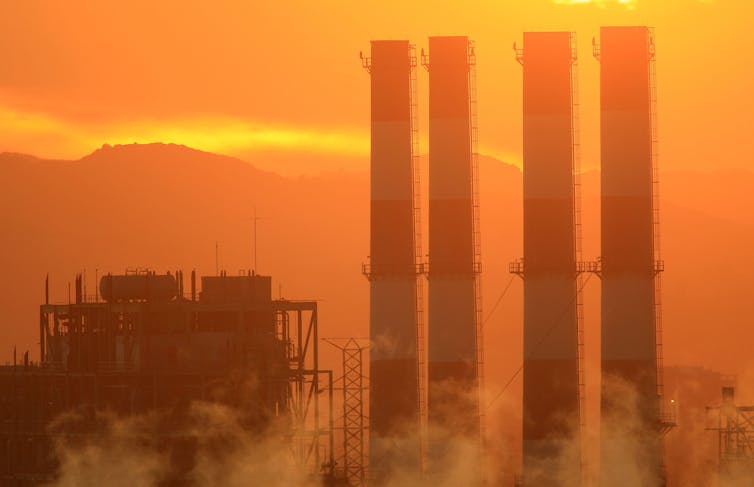 Greenhouse gases emitted today linger in the atmosphere for a long time, ranging from years to centuries. David McNew/Getty Images Julien Emile-Geay, USC Dornsife College of Letters, Arts and Sciences
In the present, a small number of people are able to doubt the fact that humans have a hand in influencing the climate of Earth. But the real issue is what speed can we take to slow down, or even reverse the effects?
Part of the answer to this question is in the notion of ” committed warming,” which is also known as “pipeline warming.”
It is a reference to future increase in temperatures across the globe that could be caused by greenhouse gases which have already been released. That is, if the transition to clean energy occurred within a few days, how much warming would still ensue?
The energy budget of Earth is out of equilibrium
Global warming is caused by humans when their activities emit greenhouse gases that trap heat in the lower atmospheric layer, which prevents the heat from venting out into the space.
When people first began burning fossil fuels to run automobiles and factories, and also to raise methane-releasing cattle in almost every region of arable, Earth’s energy budget was roughly in balance. A similar amount of energy came from the Sun as was leaving.
The current carbon dioxide levels in the air are nearly 50% higher than they were in when the industrial age. And they’re taking in more energy.
Earth’s delicate energy balance. California Academy of Sciences.
The carbon dioxide emissions that are emitted, in conjunction with other greenhouse gases such as methane, as well as compensated by some elements of aerosol air pollution, can trap energy that is equivalent to the detonation of five Hiroshima-style bombs every second.
With more energy coming in than it is leaving, Earth’s thermo energy rises, increasing temperatures of the land, oceans and air and melting ice.
The pipeline is warming
The effects of tampering with Earth’s balance of energy are gradual to be noticed. Think of the consequences of turning the hot water faucet to full blast on the cold winter days: The pipes are filled with cold water, so it requires time for the warm water to get to you , hence the name “pipeline warming.” The warming hasn’t been felt yet however it’s within the pipeline.
There are three main causes for Earth’s climate to keep warming even following the end of emissions.
The principal contributing factors of global warming – methane and carbon dioxide stay in the atmosphere for an extended period of time: around 10 years, on average for methane, and nearly 400 years for carbon dioxide, with some molecules remaining for up to millennia. Thus, shutting off emissions does not translate to instant decreases in the quantity of heat-trapping gasses within the atmosphere.
The second reason is that a portion of the warming has been offset by the man-made emission of a different form of pollution, sulfate-based aerosols. They are tiny particles produced through fossil fuel burning which reflect light into space. The past 100 years these worldwide dimming is covering up the warming impact of greenhouse gases. However, man-made aerosols also harm human health as well as life on the planet. Eliminating these and other short-lived greenhouse gases translates to a few tenths of a degree of warming additional over about a decade, before attaining a new equilibrium.

It is also true that Earth’s climate requires some time to adapt to changes to the energy balance. About two-thirds of Earth’s surface is made up of water. Sometime, this is very deep waters, that are slow to take up the extra carbon and heat. As of now, over 91% of the extra heat generated by human activity along with approximately a quarter the carbon emitted, have gone into the oceans. While land-dwellers may be grateful to have this buffer in their lives, the extra heat contributes to rising sea levels via thermal expansion and also sea heat waves as well as carbon is harmful to shelled creatures as well as disrupting the chain of food that the oceans rely on.
Temperature of the earth’s surface is influenced by the imbalance in radiation energy that is at the highest of the atmosphere, as well as modulated by the enormous thermal inertia in the oceans, is still playing catch on its largest control knob: the concentration of carbon dioxide.
How much warming?
How much committed warming will we be committing to? We don’t have a definitive answer.
The earth has already seen temperatures rise by more than 1.1 degree Celsius (2 F) compared to preindustrial temperatures. Nations worldwide agreed in 2015 to work towards preventing that the average global temperature from increasing over 1.5degC (2.7 F) to minimize the harm, however, the world is too slow to act.
Estimating how much warming is ahead is a difficult task. A number of recent studies employ climate models to predict future warming. A investigation of 18 earth model systems revealed that after emissions are cut, temperatures continued to rise for many decades or even hundreds of years while others decelerated rapidly. Another study published in June 20, 2022, discovered that there was a 42% likelihood of the earth already dedicated to 1.5 degrees Celsius.
The amount of warming matters because the dangerous consequences of global warming do not simply increase in line with the temperature of the world; they usually expand exponentially, especially in the case of the production of food at risk from the effects of drought, heat and storms.
Furthermore, Earth has tipping points that could trigger irreversible modifications to the fragile components of the Earth system like glaciers or ecosystems. We won’t necessarily know in the moment that our planet has passed a tipping point due to the fact that these changes are often slow to show out. These and similar climate-related systems serve as the foundation for the precautionary principle that helps limit warming under 2degC (3.6 F), and preferably, 1.5degC.
The root of the climate challenge, as reflected in this idea of committed warming, is the long periods of time between the way we live and the climate. While the precise amount of climate change that has been committed is an issue of debate, evidence shows the safest way forward is to swiftly move to a carbon free, more equitable economy that generates far less greenhouse gas emissions.